
By ShoeCare Team - Posted on 2026-10-20 - 8 min read
How to Remove Mould from Shoes in Dubai
Learn how to remove mould and mildew from leather, suede, and fabric shoes in Dubai. Covers safe DIY cleaning by material and when to call a professional.
Professional Shoe Care
Need Expert Shoe Care?
Schedule a pickup and let ShoeCare handle deep cleaning, restoration, and protection for your shoes.
4.9 ★
Customer Rating
7,000+
Shoes Restored
Same Day
Pickup
In This Article
- 1Why Mould Forms on Shoes in Dubai's Climate
- 2Mould vs Mildew on Shoes: How to Tell the Difference
- 3Is Mould on Shoes Dangerous?
- 4Mould on Leather Shoes: Safe Removal Steps
- 5Mould on Suede Shoes: A More Delicate Process
- 6What Causes Mould on Shoes Beyond Storage Conditions
- 7Preventing Mould on Shoes in Closets and Cupboards
- 8Mould on Your Shoes? Let the Experts Handle It
- 9When to Call a Professional Instead of DIY Cleaning
- 10Mould Removal Pricing at ShoeCare Dubai
A lot of people assume mould cannot grow in an arid city like Dubai. However, mould can still develop indoors when moisture becomes trapped in poorly ventilated spaces such as closets and shoe cupboards. This catches many residents off guard when they find white fungal growth on shoes that have been sitting in storage.
This guide explains why mould grows on footwear in Dubai, how mould and mildew differ, and which cleaning methods are suitable for different shoe materials. It also explains when home cleaning is appropriate and when professional treatment is the safer option.
Also read: How to Clean UGG Boots in Dubai, How to Clean Timberland Boots in Dubai, and How to Clean Nubuck and Suede Shoes in Dubai.
Why Mould Forms on Shoes in Dubai's Climate
Dubai's hot outdoor climate does not prevent mould growth indoors. When moisture becomes trapped in poorly ventilated spaces, mould can grow on organic materials such as leather, canvas, and fabric. The issue is not desert weather outdoors. Problems arise when humid air contacts cooler indoor surfaces, allowing condensation to form in enclosed or poorly ventilated storage areas.
Air conditioning cools closet walls and cabinets. When warm humid air meets these cooler surfaces, condensation forms. That trapped moisture combined with organic materials like leather, canvas, and cotton laces creates conditions that support mould growth even when the outdoor air feels completely dry.
Dubai's coastal setting can contribute to higher indoor humidity, particularly in waterfront areas. However, indoor ventilation, temperature, and storage conditions have a greater effect on whether mould develops than outdoor weather does. Shoes stored in poorly ventilated or damp indoor spaces are at far greater risk than shoes kept in dry, well-ventilated storage.
Shoes are particularly susceptible because their enclosed interiors retain sweat and moisture. Sweat from your feet soaks into linings and insoles, and when shoes are put away before they have fully dried, that moisture stays trapped. Poor ventilation prevents it from escaping, and over time, conditions develop that allow mould to grow.
Mould vs Mildew on Shoes: How to Tell the Difference
Not every fungal growth on footwear is the same, and the distinction matters for choosing the right cleaning approach.
Mildew generally refers to superficial fungal growth. On shoes, it may appear as a thin white, grey, or light-coloured coating sitting on the surface. When caught early, it may be easier to remove, though staining or material damage can still occur.
Mould is a broader term for fungal growth that can occur both on surfaces and within porous materials. It may appear darker, fuzzy, or slightly raised, and can present in green, black, brown, or grey depending on the species. Mould can penetrate porous materials such as leather and suede, making them significantly harder to clean thoroughly.
Appearance alone cannot reliably determine how deeply fungal growth has affected a shoe. White fungal growth can sometimes appear less severe than it is. Colour should not be used as the sole measure of how advanced the problem is or which cleaning method is appropriate.
Is Mould on Shoes Dangerous?
For most healthy adults, mould on shoes is a manageable nuisance rather than a serious health threat. However, it should not be dismissed entirely. When mouldy surfaces are disturbed during brushing or handling, microscopic spores are released into the air.
People with asthma, mould allergies, weakened immune systems, or certain respiratory conditions may be more sensitive to mould spores. Exposure can contribute to symptoms such as coughing, sneezing, itchy eyes, or breathing difficulties.
If you clean mouldy shoes yourself, do so outdoors or in a well-ventilated area to reduce the chance of spreading spores indoors. Children and anyone with respiratory conditions should avoid handling mouldy footwear when possible. The colour of mould does not tell you how dangerous it is. Focus on removing the mould safely and addressing the moisture source, rather than trying to identify the species by appearance.
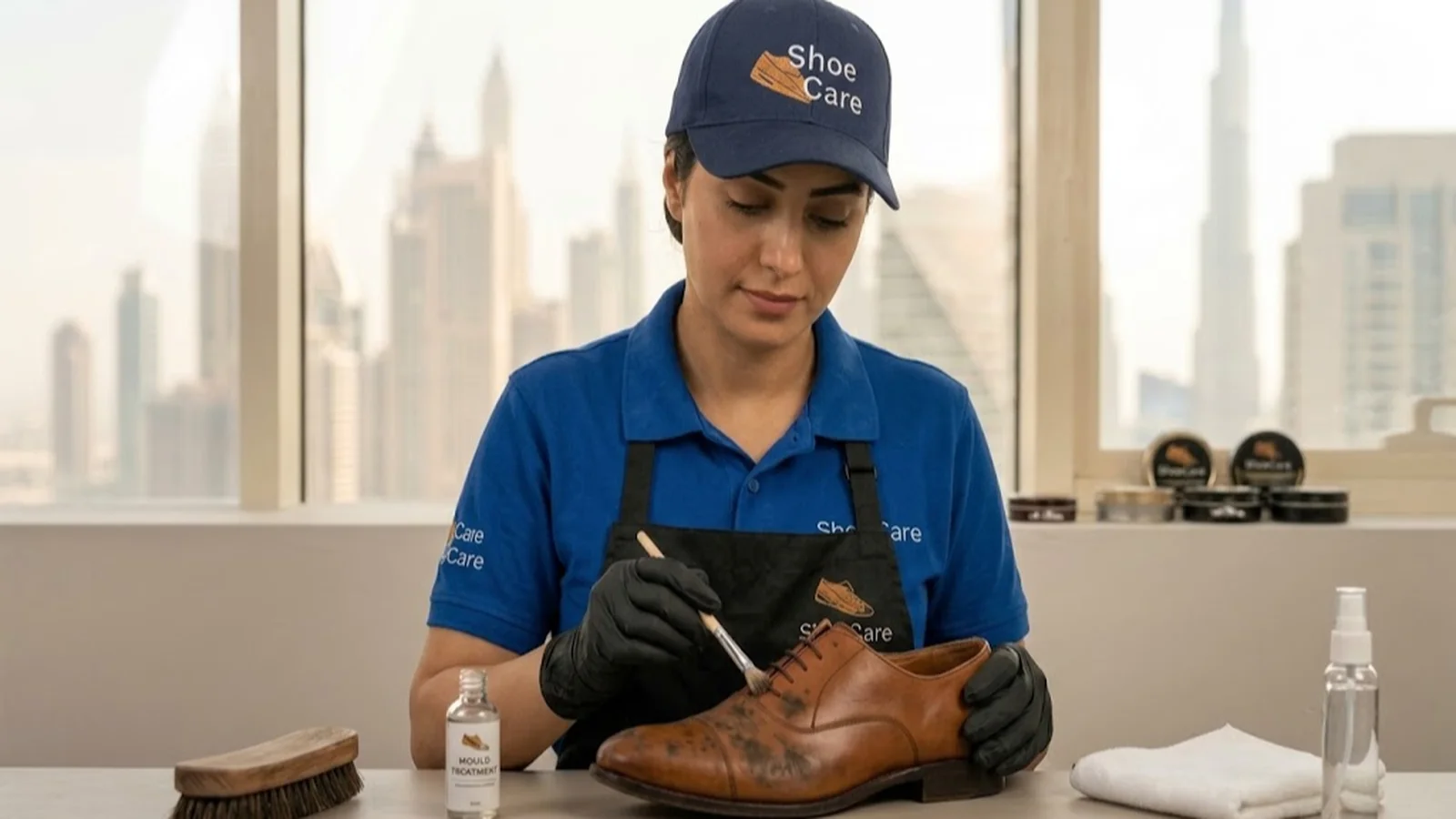
Mould on Leather Shoes: Safe Removal Steps
- Move outdoors first. Take shoes to a well-ventilated area and wear disposable gloves before handling.
- Brush off loose mould. Use a soft-bristle brush to gently remove surface growth. Pay attention to seams, welts, and leather overlaps where mould tends to accumulate.
- Wipe gently. Use a slightly damp cloth to wipe the surface. If using a cleaning solution, test it on a hidden area first. Avoid bleach, vinegar, or harsh household cleaners unless the manufacturer specifically recommends them for that leather type.
- Dry naturally. Let shoes dry in a shaded, well-ventilated area. Avoid hair dryers, heaters, and direct sunlight, as excessive heat can dry, stiffen, or crack leather.
- Condition the leather. Once fully dry, apply a suitable leather conditioner if recommended by the manufacturer.
- Address the moisture source. Fix the underlying storage or ventilation issue. Without doing so, mould is likely to return.
Mould can return if moisture or the underlying contamination is not properly addressed. Removing visible surface growth does not necessarily mean the material has been fully treated.
Mould on Suede Shoes: A More Delicate Process
Suede and nubuck are more delicate than smooth leather. Their textured nap can trap spores and is sensitive to water-based cleaners, making mould removal riskier than on smooth leather.
Start by gently brushing the surface with a dry suede brush. Use short strokes in one direction to lift loose mould without pushing it deeper into the nap. Avoid applying water directly to suede unless the product and method are specifically suited to that material.
Do not reach for household alcohol, bleach, vinegar, or general-purpose cleaning sprays. Suede and nubuck can discolour, stain, or lose their texture when exposed to unsuitable products or excess moisture. If staining or discolouration remains after brushing, professional treatment is the safer next step rather than applying more product.
After any treatment, allow the shoe to air out completely in a well-ventilated, shaded area. Once dry, restore the nap by brushing it gently with a suede brush.
Suede is one of the higher-risk materials for DIY mould removal. Its surface is easily flattened, stained, or permanently discoloured by the wrong product or too much moisture.
What Causes Mould on Shoes Beyond Storage Conditions
Storage is the biggest factor, but it is not the only one.
Sweat is an underrated contributor. Feet produce moisture throughout the day, and that moisture soaks into insoles and linings where it often does not fully evaporate before the shoe is put away.
Rain or accidental water exposure that is not followed by thorough drying is another common trigger, particularly during Dubai's short but sometimes intense rainy spells.
Shoes cleaned at home and put away before they are completely dry inside (not just outside) are a frequently overlooked cause.
Material type also plays a role. Leather and suede are more susceptible than fully synthetic uppers because they are organic and porous. Synthetic shoes are not immune, since fabric linings and insoles inside almost any shoe can still support mould growth even if the outer shell resists it.
Preventing Mould on Shoes in Closets and Cupboards
Removing mould without addressing why it grew means the problem will return. Preventing mould starts with airflow, since sealed, unventilated cupboards create exactly the conditions mould needs.
Never store shoes while even slightly damp, whether from sweat, rain, or a recent clean. This is the single most common trigger for mould in closed storage. Leave a small gap between shoes on a rack rather than stacking them tightly, and consider leaving closet doors cracked open periodically rather than permanently sealed.
Silica gel packets placed inside shoes can help absorb small amounts of residual moisture, but they are not a substitute for ventilation or humidity control. For built-in wardrobes along exterior walls, where condensation is more likely, a small dehumidifier or moisture-absorbing product inside the wardrobe can meaningfully reduce humidity buildup.
Rotating footwear rather than leaving the same pair unworn at the back of a closet for months helps too. Allowing shoes to dry fully between uses reduces moisture buildup, particularly when they have absorbed sweat during wear.
Mould on Your Shoes? Let the Experts Handle It
ShoeCare uses material-specific cleaning and restoration techniques for mould-affected leather, suede, and fabric footwear. Free pickup across Dubai within four hours.
Schedule Free PickupWhen to Call a Professional Instead of DIY Cleaning
Home remedies work for light, surface-level mildew caught early. There are clear signs, however, that DIY treatment is unlikely to fully resolve the problem, and pushing further with more aggressive home methods at that point risks the shoe rather than saving it.
If mould keeps returning after cleaning, especially in the same spot, moisture may still be present or the material may require more thorough treatment than a surface wipe can reach.
If a musty smell remains after fully drying, moisture, mould, or contamination may still be present inside the shoe even if the surface looks clean.
Designer, suede, or nubuck shoes carry the highest risk with DIY treatment. A single wrong product can permanently alter colour or texture, and the cost of that mistake is far higher than on a basic pair of sneakers.
ShoeCare uses material-specific cleaning and restoration techniques designed to treat mould-affected footwear while reducing the risk of damage to leather, suede, and other delicate materials. Every service includes free pickup and delivery across Dubai, with pickup available within four hours and shoes typically returned within two to three days. Sports sneaker cleaning starts from AED 95, and boot cleaning is AED 170.
Mould Removal Pricing at ShoeCare Dubai
| Service | Price (AED) |
|---|---|
| Sports Sneaker Cleaning | 95 |
| Casual Shoe Cleaning | 120 |
| Designer Shoe Cleaning | 145 |
| Boot Cleaning (leather, suede, shearling) | 170 |