
By ShoeCare Team - Posted on 2026-10-06 - 12 min read
How to Clean Air Jordan Sneakers in Dubai: Material Guide
Air Jordans are built from at least four different materials, and cleaning them all the same way is the single biggest reason collectors damage their own pairs. This guide covers leather, suede, mesh, and patent leather Jordan care, why Dubai heat yellows soles faster, and when professional cleaning is worth it.
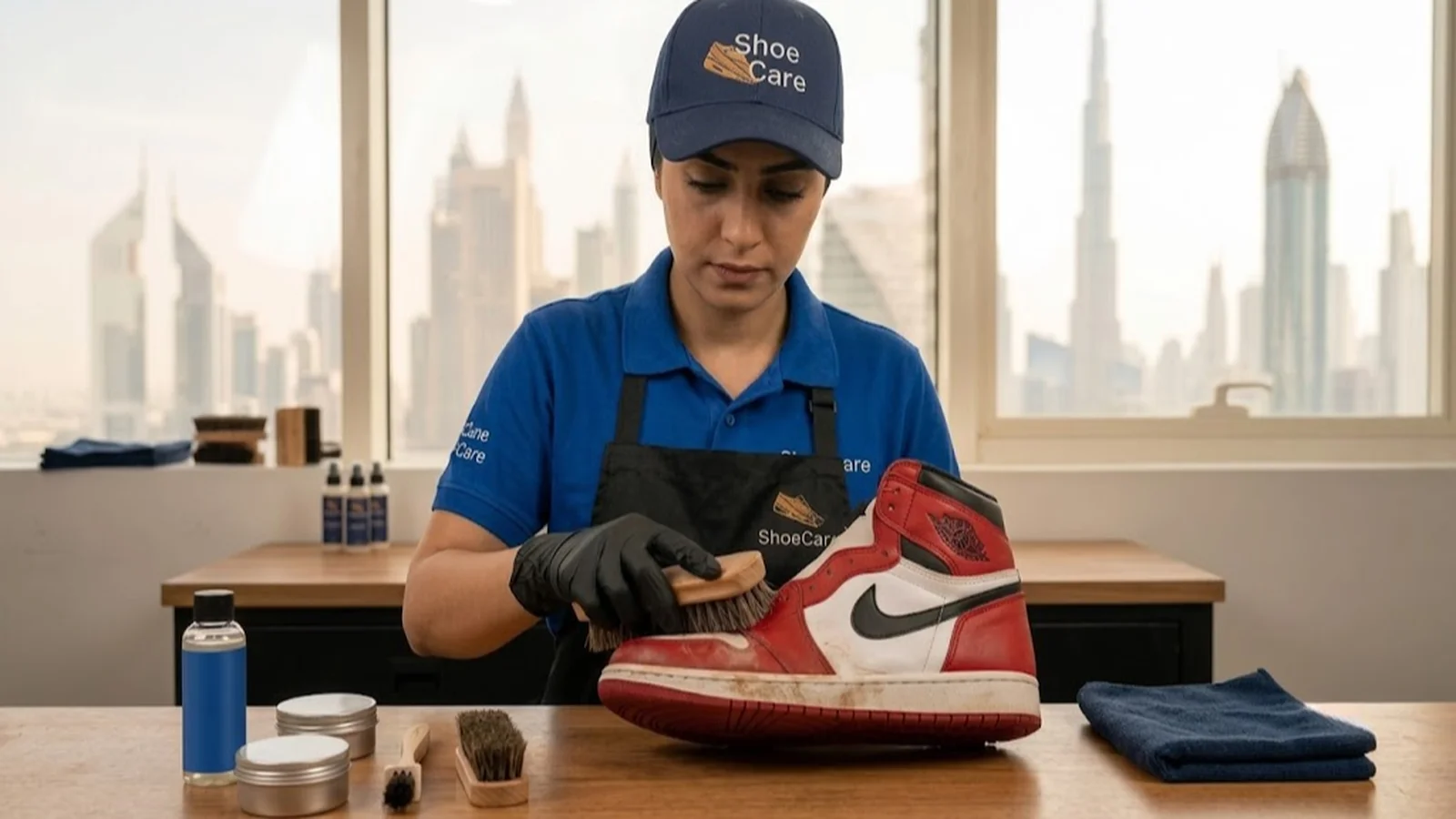
Professional Shoe Care
Need Expert Shoe Care?
Schedule a pickup and let ShoeCare handle deep cleaning, restoration, and protection for your shoes.
4.9 ★
Customer Rating
7,000+
Shoes Restored
Same Day
Pickup
In This Article
- 1Why Dubai changes the approach to cleaning Jordans
- 2Identify your Jordan's material before you touch it
- 3How to clean leather Jordans (AJ1, AJ4, AJ5)
- 4How to clean suede Jordans (AJ6, AJ12) without water
- 5How to clean mesh and engineered fabric Jordans (AJ11, AJ36)
- 6How to clean patent leather Jordans (AJ11 toe cap and heel)
- 7The yellowing problem: why icy soles and white midsoles turn faster in Dubai
- 8Laces and insoles: the step most people skip
- 9Common mistakes that damage Jordans in Dubai specifically
- 10When to clean at home and when to book a professional service
- 11Air Jordan cleaning pricing in Dubai
TL;DR
- Air Jordans are not one material, and cleaning them like they are is the single biggest reason collectors damage their own pairs.
- Leather Jordans (AJ1, AJ4), suede Jordans (AJ6, AJ12), mesh Jordans (AJ11, AJ36), and patent leather Jordans (AJ11) each need a different cleaning approach, water tolerance, and drying method.
- Dubai's heat and sun exposure speed up the oxidation that yellows white midsoles and icy soles far faster than in cooler climates, which changes how often Jordans here actually need attention.
- Fine desert sand works into mesh panels and stitch lines in a way ordinary street dust does not, making mesh-heavy Jordans more vulnerable in Dubai than global cleaning guides account for.
- Suede and nubuck Jordans should never be cleaned with water in Dubai's humidity swings. For anything beyond a light dry-brush, professional sneaker cleaning protects both the material and the resale value of a serious pair.
Air Jordans are not a single product with one cleaning method. The Air Jordan 1 is built from leather. The Air Jordan 6 and 12 lean heavily on suede. The Air Jordan 11 mixes patent leather with mesh. The Air Jordan 36 is almost entirely engineered mesh. Treat all four the same way, with the same brush and the same solution, and at least one of them comes out worse than it went in.
This guide breaks down how to clean Air Jordans by material, what Dubai's climate specifically does to each one, and where a DIY clean reaches its limit. It also covers the yellowing problem that affects nearly every white or icy-soled Jordan model, and why it shows up faster here than global guides suggest.
Also Read:
How to Clean Mesh and Knit Sneakers in Dubai: Full Guide
How to Clean Patent Leather Shoes in Dubai: A Safe Guide
How to Clean Hiking Boots in Dubai: Desert Trail Care Guide
Why Dubai changes the approach to cleaning Jordans
Most Jordan cleaning guides are written assuming a moderate climate. Dubai is not that.
Sun and heat exposure accelerate the oxidation reaction that turns white midsoles and icy soles yellow. The chemical process is the same everywhere, but Dubai's sun intensity and ambient heat speed it up. Yellowing on white and icy-sole Jordan models tends to appear on a shorter timeline here than in temperate cities.
Fine desert sand is a second factor global guides never mention. It is drier and finer than typical urban dust, and it settles into mesh weaves and stitch lines rather than sitting on the surface. On mesh-heavy models like the Air Jordan 11 and Air Jordan 36, this means dirt sits deeper in the material before it becomes visible, and a quick surface wipe leaves most of it behind.
The daily swing between air-conditioned interiors and outdoor heat adds a third pressure. Warm sneakers that go straight into a cold AC environment, or the reverse, go through a moisture cycle that can trap dampness inside the shoe. For suede and nubuck Jordans, this cycling makes water-based cleaning riskier than it looks, because trapped moisture in suede fibers does not evaporate as cleanly as it would in a drier climate.
None of this means Jordans cannot be kept clean in Dubai. It means the cleaning method has to account for these specific conditions rather than following generic advice built for somewhere else.
Identify your Jordan's material before you touch it
Air Jordan models vary widely in upper material, and each one reacts to water, brushes, and cleaning agents differently. Using the wrong method on the wrong material causes more damage than the original dirt.
Leather is the classic Air Jordan material, most visible on the AJ1 and AJ4, with leather panels on several AJ5 colorways. Leather tolerates a damp cloth and mild soap reasonably well.
Suede and nubuck appear heavily on the AJ6 and AJ12. These are the most delicate uppers in the lineup and the ones where a single wrong move causes visible, often permanent, damage.
Mesh and engineered fabric dominate models like the AJ11 and AJ36. Mesh is breathable but porous, which means stains and dust sink into the weave rather than resting on top of it.
Patent leather, best known from the AJ11's toe cap and heel, has a glossy sealed finish. It resists staining better than other materials but shows fingerprints, scuffs, and fine scratches immediately.
How to clean leather Jordans (AJ1, AJ4, AJ5)
Leather is the most forgiving Jordan material, but forgiving is not the same as indestructible.
Remove the laces and insoles first. Use a soft-bristled brush to knock off loose dirt and dust before introducing any moisture, since brushing wet dirt into the leather grain pushes it deeper.
Mix a small amount of mild soap into cool water. Dip a soft cloth, wring it out until it is barely damp, and wipe the leather with the grain rather than against it. Going against the grain on leather scuffs the surface and can leave streaking that is difficult to reverse.
For scuffs specifically, a lightly dampened microfiber cloth with gentle circular motion usually lifts them without needing anything stronger. Avoid saturating leather uppers. Leather absorbs water more readily than people expect, and excess moisture works into the material and toward the glue line at the sole, which is exactly where Dubai heat has already been softening the adhesive bond throughout the day.
Once clean, wipe down with a barely damp cloth to remove soap residue, then air dry away from direct sunlight. Direct Dubai sun on a wet leather upper accelerates drying unevenly, which can cause stiffening or slight warping at the edges.
How to clean suede Jordans (AJ6, AJ12) without water
This is the section where most DIY attempts go wrong, and where Dubai's climate makes the standard advice even riskier than it already is.
Start dry. Stuff the shoe with a balled-up cloth to hold its shape, then use a dedicated suede brush in one consistent direction to lift loose dirt and restore the nap. This step alone resolves a surprising amount of everyday dulling without any liquid involved.
Address stains with a suede eraser first, not water. A suede eraser or a clean pencil eraser lifts many scuffs and light marks through friction alone.
If you must use moisture, use almost none. A barely damp cloth on a very localized stain is the outer limit of what suede should see. Full submersion, heavy scrubbing with a wet brush, or dish soap solutions are common online recommendations that damage suede's texture permanently, flattening the nap in a way that does not restore itself.
Dyed suede is a special risk. Colored suede, common on several AJ6 and AJ12 colorways, can bleed when it gets wet. If you are not certain the dye is stable, do not introduce water at all.
Here is where Dubai specifically raises the stakes. Suede absorbs moisture readily and releases it slowly. In a climate with daily humidity swings between air-conditioned indoor air and hot outdoor air, suede that has taken on any moisture does not get a clean, steady drying window. That trapped moisture leads to a musty smell, fiber matting, or in worse cases, mold developing inside the shoe before it has fully dried through.
For anything beyond light dry-brushing and eraser work, suede is the material where professional cleaning earns its cost. A suede-safe deep clean uses solvent-based products and controlled drying specifically designed to avoid the water-absorption problem, which is difficult to replicate safely at home.
How to clean mesh and engineered fabric Jordans (AJ11, AJ36)
Mesh looks simple to clean and is actually one of the more deceptive materials on this list, because dirt does not sit where you can see it.
Remove laces and insoles, then use a soft brush to work loose surface dirt out of the weave before adding water. Mix mild soap with cool water and use a soft-bristled brush in gentle circular motions, focusing on sections rather than scrubbing the whole upper at once.
For mesh panels specifically, avoid pressing hard. Mesh stretches under pressure and can tear or lose its shape if scrubbed aggressively, particularly around seams where mesh meets a leather or synthetic overlay.
This is the model category where Dubai's fine desert sand matters most. Because the sand is finer and drier than typical urban dust, it settles between the mesh fibers rather than resting on the surface. A Jordan that looks clean on inspection can still have sand embedded in the weave. A single quick wipe will not resolve this. A soak-and-rinse approach, submerging the mesh sections briefly in lukewarm water with a mild cleaning solution, works the embedded particles out more completely.
After cleaning, air dry only, away from direct sun and any heat source. Heat drying softens the foam midsole and can warp mesh panels out of shape.
How to clean patent leather Jordans (AJ11 toe cap and heel)
Patent leather's sealed, glossy surface is the easiest material on this list to clean day to day, and the easiest to damage with the wrong product.
A microfiber cloth with a small amount of gentle cleaner or diluted mild soap is usually enough to lift fingerprints, light scuffs, and dust. Wipe gently rather than scrubbing, since patent leather's coating can scratch under abrasive pressure or a stiff brush.
Avoid alcohol-based cleaners and anything with a strong solvent, both of which can dull or crack the glossy coating over time. In Dubai's heat, a patent leather upper that sits in direct sun for extended periods can also become slightly tacky, which makes it more prone to picking up dust and fine sand. Wiping patent panels down after outdoor wear, rather than waiting for visible dirt to accumulate, keeps the surface from building up a residue layer that is harder to remove later.
The yellowing problem: why icy soles and white midsoles turn faster in Dubai
Almost every Jordan owner eventually deals with yellowing, whether it is the icy translucent sole on an Air Jordan 11 or a plain white midsole on nearly any model. The underlying cause is oxidation, a chemical reaction between the sole material and oxygen that gradually shifts how the material reflects light.
What changes in Dubai is the speed. UV exposure and heat both accelerate oxidation, and Dubai offers an abundance of both for most of the year. A pair that might take a year or more to visibly yellow in a cooler, cloudier climate can show clear signs within a few months of regular Dubai wear, especially if the shoes are stored near direct sunlight, such as a windowsill or an unshaded shoe rack near a balcony door.
Basic maintenance slows this down. Cleaning white and icy soles regularly, rather than waiting for visible yellowing, removes the dirt and sweat residue that compounds the oxidation process. Once yellowing has already set in, at-home fixes have real limits. Correcting it properly usually requires a specialized sole treatment applied evenly and left to cure under controlled UV exposure. A professional color and sole restoration service handles this evenly across the whole sole, which matters both for appearance and for resale value on higher-demand colorways.
Laces and insoles: the step most people skip
Laces and insoles hold as much dirt, sweat, and odor as the upper itself, and skipping them undercuts an otherwise good clean.
Remove both before starting on the shoe. Soak laces in warm water with a small amount of mild detergent, agitating gently every few minutes, then scrub lightly and air dry. For insoles, a soft brush with mild soap on both sides handles most dirt and sweat buildup, followed by full air drying before reinserting them. Reinserting a damp insole into a Dubai interior is one of the more common causes of lingering odor in an otherwise clean pair.
Common mistakes that damage Jordans in Dubai specifically
Machine washing. Heat, tumbling, and spin cycles warp foam midsoles and weaken the adhesive bonds holding the sole to the upper. Those bonds are already under more stress in Dubai's heat, which makes machine washing a faster route to sole separation here than the same mistake would be elsewhere.
Hot water. Warm or hot water softens adhesives further and can set stains rather than lift them. Cool water only, on every material.
Bleach. Bleach yellows synthetic materials rather than whitening them, and it breaks down fiber structure even on white pairs. It is one of the most commonly recommended home remedies online and one of the most consistently damaging.
Direct sun drying. A wet Jordan set out in direct Dubai sun to dry faster accelerates uneven material stress and, on white soles, actively speeds up the oxidation process. Air dry indoors, away from direct light and heat.
Storing near windows or balcony doors. Even without a recent cleaning, prolonged sun exposure on stored Jordans is one of the more overlooked yellowing accelerants in Dubai homes.
When to clean at home and when to book a professional service
Light dry-brushing, dusting off sand, wiping down leather, and spot-cleaning patent panels are reasonable to do at home with the right tools. These are low-risk maintenance tasks that keep a pair looking presentable between deeper cleans.
Professional service becomes the more reliable option for suede and nubuck models beyond basic dry-brushing, for embedded sand and staining on mesh-heavy pairs, for yellowed soles and midsoles that need even and controlled restoration, and for any pair where resale value or rarity makes an at-home mistake too costly to risk.
Book Air Jordan Cleaning in Dubai
Free pickup across Dubai within 4 hours. Each Jordan material cleaned with the right process for that surface. Shoes returned within 2 to 3 days with a Zero Stain Guarantee.
Schedule Free PickupAir Jordan cleaning pricing in Dubai
| Service | Price (AED) |
|---|---|
| Sports Sneaker Cleaning | 95 |
| Casual Sneaker Cleaning (standard leather, canvas, mesh) | 120 |
| Designer Sneaker Cleaning (limited release, suede, patent leather) | 145 |
| Sneaker Colour Restoration (icy sole and midsole yellowing) | 145 |