
By ShoeCare Team - Posted on 2026-10-12 - 9 min read
How to Fix Creases in Leather Sneakers in Dubai
Learn how to safely reduce creases in leather sneakers at home in Dubai and when it is better to stop DIY repairs and seek professional help.
Professional Shoe Care
Need Expert Shoe Care?
Schedule a pickup and let ShoeCare handle deep cleaning, restoration, and protection for your shoes.
4.9 ★
Customer Rating
7,000+
Shoes Restored
Same Day
Pickup
In This Article
- 1Why Do Leather Sneakers Crease in the First Place?
- 2Can You Remove Creases From Shoes Completely?
- 3How Do You Remove Creases From Shoes With a Damp Cloth and Iron?
- 4Can You Use Steam or a Hair Dryer Instead?
- 5Is There a Way to Fix Creases Without Heat?
- 6What Mistakes Make Creases Worse in Dubai's Heat?
- 7How Can You Prevent Creases in Leather Sneakers?
- 8When Should You Stop DIY and Call a Professional?
- 9Creases Too Deep to Fix at Home?
- 10Leather Sneaker Care Pricing at ShoeCare Dubai
Leather sneakers can be affected by Dubai's hot outdoor temperatures and dry indoor air from air conditioning. Repeated changes between hot outdoor conditions and cool, dry indoor spaces can gradually dry out leather and make it less flexible, which may make creasing more noticeable.
This guide explains why leather sneakers crease, whether heat or steam can reduce creases, and which at-home methods are safest. It also covers conditioning, crease prevention, and when to seek professional help.
Also read: How to Remove Mould from Shoes in Dubai, How to Clean UGG Boots in Dubai, and How to Clean Air Jordan Sneakers in Dubai: Material Guide.
Why Do Leather Sneakers Crease in the First Place?
The toe box bends every time you walk. As this happens repeatedly, the leather fibers in the crease can become stressed and develop a permanent fold. Over time, the crease may remain visible even when the shoes are not being worn.
An oversized shoe can also crease more because your foot moves inside the shoe. Extra space around the toe box can cause the upper to fold more as you walk. The way leather creases depends on its thickness, flexibility, finish, and construction. Full-grain leather can crease too, and thinner leather does not always crease more than thicker leather.
In Dubai, three local factors speed this up:
- Air-conditioned indoor environments can have low humidity, which may contribute to leather drying out over time. However, repeated bending during walking and the shoe's fit are the main factors behind creasing.
- Heat exposure. Prolonged exposure to heat and direct sunlight can dry out or damage leather, affect its finish, and weaken adhesives. Store sneakers in a cool, shaded place rather than in a hot car or on an exposed balcony.
- Sand and dust in folds. Fine grit works into creases and acts like sandpaper, wearing the finish along a fold line.
Can You Remove Creases From Shoes Completely?
The honest answer depends on the depth of the crease.
A light surface crease appears during the early stages of use and generally responds well to treatment. If the leather is still intact, gentle conditioning and controlled shaping may help reduce the appearance of a light crease.
Deep creases are different. After months of use, the fold line is stretched and thinned out, and the surface finish may be showing micro-cracks. While heat may soften wrinkles temporarily, it does not repair fibers that are permanently damaged. The realistic goal is to reduce the crease rather than remove it completely.
A quick guide to judging your situation:
- Light surface crease: A shallow line that appears when the shoe bends but is less noticeable when the shoe is at rest. It can often be reduced with careful at-home care.
- Set crease: The line remains visible while the shoe is at rest, but the finish stays intact. Techniques can improve the appearance, but a trace may remain.
- Cracked crease: The surface finish is cracking, peeling, or flaking along the fold. At this stage, the leather needs repair or restoration rather than repeated crease-removal treatments.
How Do You Remove Creases From Shoes With a Damp Cloth and Iron?
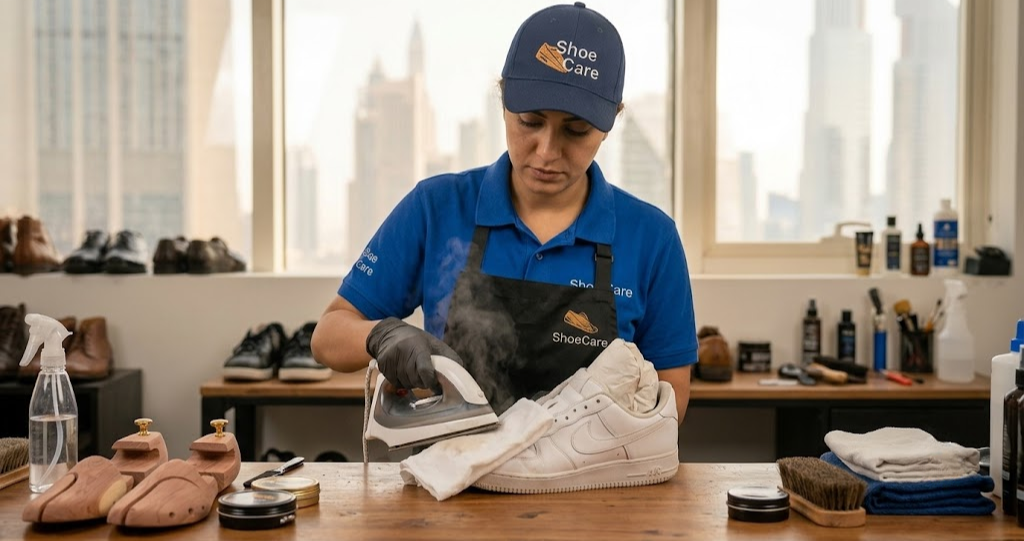
Ironing is a popular technique for reducing shoe creases, but it carries real risk on leather. Gentle warmth can make some leather more flexible, but too much heat or moisture can damage the finish, cause discoloration, or affect adhesives. If you use this method, keep the heat very low and avoid direct contact with the leather.
You will need a shoe tree or tightly packed newspaper, a clean cotton towel, a household iron, and leather conditioner.
Step 1: Clean the sneakers first
Remove all dirt and grit before applying any heat. Dirt trapped in creases can scratch the leather or damage its finish when pressure and heat are applied.
Step 2: Stuff the toe box firmly
Remove the laces and fill the toe box so the leather is supported from underneath, but do not overstuff it or force the leather into an unnatural shape.
Step 3: Dampen the cloth
The cloth should be damp, not dripping. Excess moisture can leave water stains on leather surfaces.
Step 4: Apply very low indirect heat
Using an iron on leather sneakers carries a risk of scorching, shrinkage, discolouration, finish damage, and adhesive failure. The safest option is to use a properly fitted shoe tree and follow the manufacturer's care instructions. If heat treatment is appropriate for the specific leather, use a method recommended by a qualified shoe-care professional rather than applying a household iron directly.
Place a damp towel over the toe box and briefly apply the iron on the lowest setting. Check every few seconds for any signs of damage. Do not allow direct contact between the iron and the leather.
Step 5: Smooth the crease while warm
While the leather is slightly warm, gently smooth the creased area over the stuffed toe box using your fingers.
Step 6: Let the shoe cool completely before wearing
Leave shoes to cool fully while supported. Wearing them while still warm can allow new creases to form because the leather remains pliable at that stage.
Repeat in short rounds rather than one long session. Patience matters more than heat.
Can You Use Steam or a Hair Dryer Instead?
A hair dryer can be easier to control than an iron, but both heat and steam can damage some leather finishes. Use the lowest practical heat setting and keep the source moving across the surface.
Steam can soften some types of leather, but it also carries a higher risk of moisture damage and finish changes. Unless the manufacturer's care instructions allow steaming, avoid using a garment steamer on painted, coated, suede, or delicate leather.
Warming the creased area with a hair dryer on a low setting while pressing the leather over a shoe tree is the least aggressive heat method for reducing creases, though it may not be as effective as a controlled iron technique.
Whichever heat method you choose, keep the heat controlled and avoid concentrating it on one area for too long.
Is There a Way to Fix Creases Without Heat?
Yes. For leather that is already dry or for sneakers with delicate finishes, a no-heat approach is safer.
Apply a small amount of leather conditioner to the creased area and work it in with a soft cloth. A leather conditioner formulated for the shoe's specific finish may help improve flexibility if the leather is dry. Combined with a properly fitted shoe tree, it may improve the appearance of shallow creases, but it will not reverse structural damage. Stuff sneakers firmly and leave them overnight.
This method is slower and may need to be repeated over several days for a set crease. It also avoids the heat-related risks of burning, shrinking, or discolouring the leather. If the leather is becoming dry, suitable conditioning may help maintain its flexibility. However, creasing is a normal result of walking, and conditioner cannot prevent it entirely.
What Mistakes Make Creases Worse in Dubai's Heat?
A few habits turn a fixable crease into a permanent one:
- Ironing directly on leather. Direct contact may result in shiny spots, burns, or an uneven finish.
- Using high heat. Leather is a skin. High heat causes shrinkage and hardening.
- Skipping conditioner. Skipping conditioner can leave leather dry and less flexible, which may make existing creases more noticeable and increase the risk of cracking.
- Wearing sneakers while still warm. Let the shoes cool completely while supported by a shoe tree or stuffing so they retain their reshaped form.
- Leaving sneakers in a hot car. Extreme heat can dry, shrink, discolor, or weaken leather and may also affect the shoe's adhesives.
- Treating painted or coated leather as unpainted leather. Some designer sneakers have painted, coated, or specially finished surfaces that can react badly to heat, causing the finish to crack and creating cosmetic damage.
How Can You Prevent Creases in Leather Sneakers?
Prevention is easier than correction. A few habits can make a real difference.
- Use shoe trees after each wear. Insert shoe trees after wearing your sneakers and allow them to cool naturally while supported.
- Rotate your pairs. Wearing the same pair every day does not give the leather time to recover. Rotating your sneakers gives the leather and lining time to dry between wears.
- Condition regularly. Dubai's air conditioning creates a drier indoor environment than you might expect. Light conditioning on a regular basis helps keep leather pliable.
- Check fit before buying. Choose a shoe that fits securely without being too loose. Excess space can allow your foot to move inside the shoe, which may increase creasing.
- Use crease protectors carefully. Crease protectors are inserts placed inside the toe box to reduce how much the upper folds during walking. They may slow the development of new creases, but they cannot eliminate creasing entirely. Test them for comfort during a short walk before wearing them for long periods.
- Store away from sunlight and heat. A cool, shaded closet is better than a balcony, windowsill, or car interior.
When Should You Stop DIY and Call a Professional?
Home methods have a ceiling. Stop and have the pair assessed when any of these apply:
- The finish is cracking, peeling, or flaking along the crease line.
- The sneakers are expensive designer or limited-edition pairs, or are made with coated, painted, or specially finished leather.
- The leather develops unusual yellowing, darkening, or discoloration after heat or cleaning.
- Despite stuffing, conditioning, and gentle heat, the crease returns immediately.
- The toe box has lost its shape, or the sole is beginning to separate at the crease, suggesting an adhesion problem.
Professional work goes beyond what a household iron can do. A shoe-care specialist can assess the leather and finish, clean the affected area, and determine whether reshaping, conditioning, or shoe colour restoration Dubai is appropriate. If the leather itself is cracked or structurally damaged, complete crease removal may not be possible. The longer a crease is left untreated, the deeper it sets and the fewer options remain.
Creases Too Deep to Fix at Home?
ShoeCare handles leather sneaker cleaning, conditioning, and colour restoration with free pickup across Dubai in four hours.
Book Sneaker Cleaning DubaiLeather Sneaker Care Pricing at ShoeCare Dubai
| Service | Price (AED) |
|---|---|
| Casual Sneaker Cleaning | 120 |
| Designer Sneaker Cleaning | 145 |
| Sneaker Colour Restoration | 145 |
| Shoe Stretching | 65 |